

What you need in place before strategy season
Most leadership teams start their strategy cycle either stretched from Q2 reporting, or too newly arrived to know what funders actually think. The work that determines whether the strategy changes anything happens before the strategy itself begins.
Virginia Simpson · SignalWork · 2 May 2026
Every year, sometime around September, the strategy cycle kicks in. UNGA happens. The conference circuit starts. Boards want to see next year's plan. And almost every mission-driven organisation I work with makes the same mistake: they start planning before they have done the research.
They pull last year's financials. They update the pipeline deck. They book a strategy away day. But none of that answers the question that actually determines the impact of next year's strategy: what do the people who fund you currently think about you, and why?
The pattern we keep seeing
We have conducted over 320 confidential interviews with funders, programme partners, and board members across the UK, Europe, Southern Africa, and the US. The same pattern appears in almost every organisation we work with, regardless of size, sector, or geography.
The leadership team believes it knows where it stands with its funders. It has CRM data. It has NPS scores. It has the outcome of the last grant application. What it does not have is what those funders actually think. Why the relationship that scored 8 out of 10 in satisfaction is about to end. Why the board member who attends every meeting has stopped advocating behind closed doors. Why the programme officer who loves your work cannot get internal sign-off for a larger commitment.
The intelligence that matters most does not live in your CRM. It does not surface in a survey.
It exists in the space between what people say on the record and what they say to a trusted independent outsider when nobody else is in the room. By September, if you have not gathered it, you are making strategic decisions on incomplete information.
What should be in place before strategy season
Based on the work we do with organisations preparing for strategy cycles, here is what the evidence base should look like before you sit down to plan. Not all of it will apply to every organisation. But if you are missing most of it, your strategy work is built on assumptions, not intelligence.
Stakeholder intelligence
What do your funders, partners, and board members actually think? Not what they said in the last review meeting. What they think privately. Where do they see you in the market? How do they describe you to their colleagues? What would have to change for them to fund you at a different level? This is the foundation. Everything else builds on it.
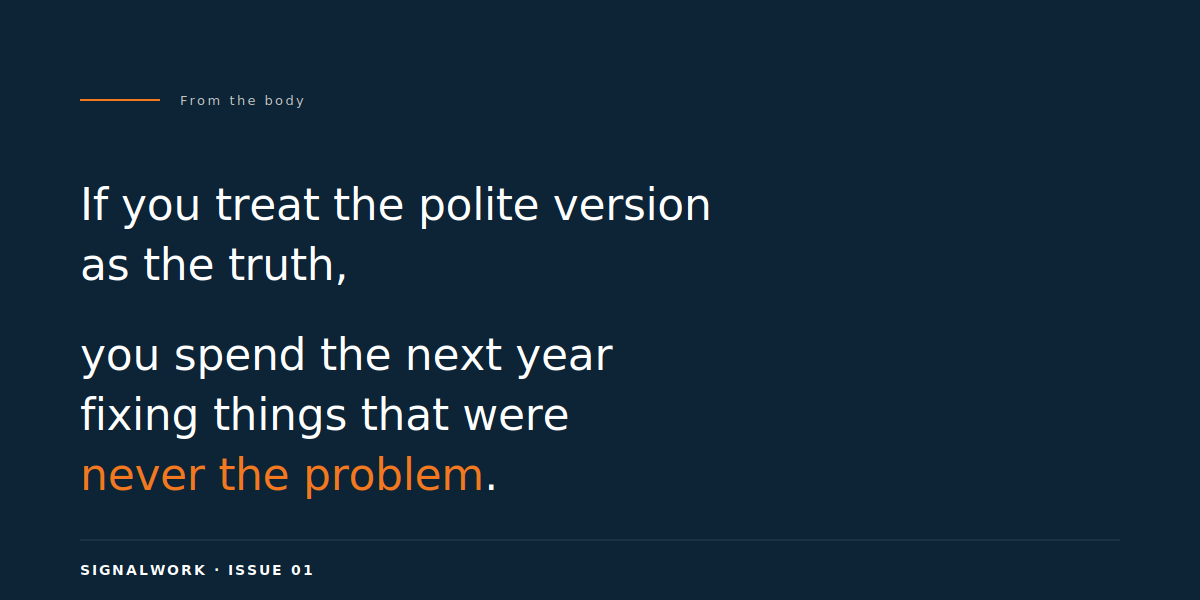
A specific version of this is worth flagging, because it is the assumption I see most often and it is almost always wrong. When a proposal is rejected, or simply goes quiet without a clear answer, the temptation is to assume something internal went wrong: the proposal was off, the positioning was weak, the relationship had cooled. In my experience, the real reasons rarely sit there. They sit inside the funder. A competing priority elsewhere in the portfolio. A programme officer who could not get internal sign-off. A board member who pushed for someone else. None of that ever makes its way back to you in the rejection email, or in the silence that sometimes replaces one, because saying it out loud would be self-incriminating for the funder. They give you the polite version, the one that protects them. And honestly, who can blame them. To be fair to the funders in this story, the best ones I speak to know exactly what is happening, and many of them are frustrated by it themselves. The pattern I hear most often is the same one in different language: a funder says they want to back you, but they cannot win the internal argument because you have not given them the evidence they need to take to their own board.
Unit economics
This is the one most organisations have never done properly, and it is the one that changes the conversation. Not your top-line revenue. Not your pipeline forecast. What each engagement actually earns once delivery costs are stripped out. Which funders cost you money to service. Which income streams look healthy on a dashboard but generate negative margin when you account for the staff time, travel, and reporting burden behind them. Pipeline numbers are easy to inflate; unit economics are not. When you sit down with your board and show them what engagement-level margin analysis looks like, the strategic priorities become obvious. The programmes you thought were your strengths may be subsidised by one anchor funder. The income stream you have been growing may be the one that is quietly draining the organisation. This analysis takes weeks, not months. But almost nobody does it before strategy season, which means the plan that comes out of the away day is built on numbers that look right but are not.
Pipeline analysis
Win rates, conversion rates, income stream concentration. Where is your pipeline clustered? What is your dependency on your top three funders? If your largest funder walked away tomorrow, how long would it take you to replace that income? The answer to that question should shape every strategic decision you make.
Market intelligence
What funders are willing to pay for, and at what price, in your chosen practice areas. What the competition looks like in each geography. How peers with similar offerings have built their recurring revenue. What took them two years versus what took five. This is not desk research. It comes from talking to the people who make funding decisions and understanding what they are actually looking for.
Competitive positioning
How do funders see you relative to your peers? Not how you see yourself. This is where the perception gap lives. We have worked with organisations that had strong delivery track records and weak philanthropic positioning. The work was excellent. The way they were seen in the market did not match it. That gap, between what you do and how you are experienced, is usually the single biggest barrier to income growth. And most organisations do not know it exists until someone independent asks the question.
The cost of skipping it
When organisations skip this research phase, the strategy work that follows is predictable. The away day produces a plan that looks a lot like last year's plan with slightly higher targets. The board approves it because there is nothing to challenge it against. The team goes back to doing what it was already doing. Income stays flat or declines. And twelve months later, the cycle repeats.
The organisations that break this pattern are the ones that invest in the evidence base before they start planning. They arrive at the strategy conversation with a clear picture of how they are perceived, where the money is, what the competition looks like, and what needs to change. The plan that comes out of that room is different. It is grounded in intelligence, not assumptions. And it is one the team can actually execute, because the priorities are backed by data the board can see and funders have already confirmed in private.
The timing
The research phase takes eight to twelve weeks if done properly. There is no single right starting point, and there are several windows that work. Starting in June gives you the cleanest run, with findings ready to feed into the strategy conversation in September. Starting in July or August is harder, because so much of the funder world is on holiday, and meaningful interviews are difficult to land. Starting in September is still entirely workable: findings can land in November, in time to shape the board conversation, even if the strategy is already taking shape around them. The point is that there are several entry points between now and the autumn, and the worst option is to assume you have missed the window. You have not.
If you are a CEO or a Head of Strategy reading this, the question is not whether you can afford to do this research. It is whether you can afford to go into another strategy cycle without it.
SignalWork is a strategic advisory that surfaces what funders, stakeholders, and programme partners actually think but will not say publicly. We have conducted over 320 confidential senior interviews across the UK, Europe, Southern Africa, and the US. Clients include Centre for Public Impact, Carbon Trust, Tony Blair Institute, and Co-Impact.
If this is sitting with you, get in touch.